close
Choose Your Site
Global
Social Media


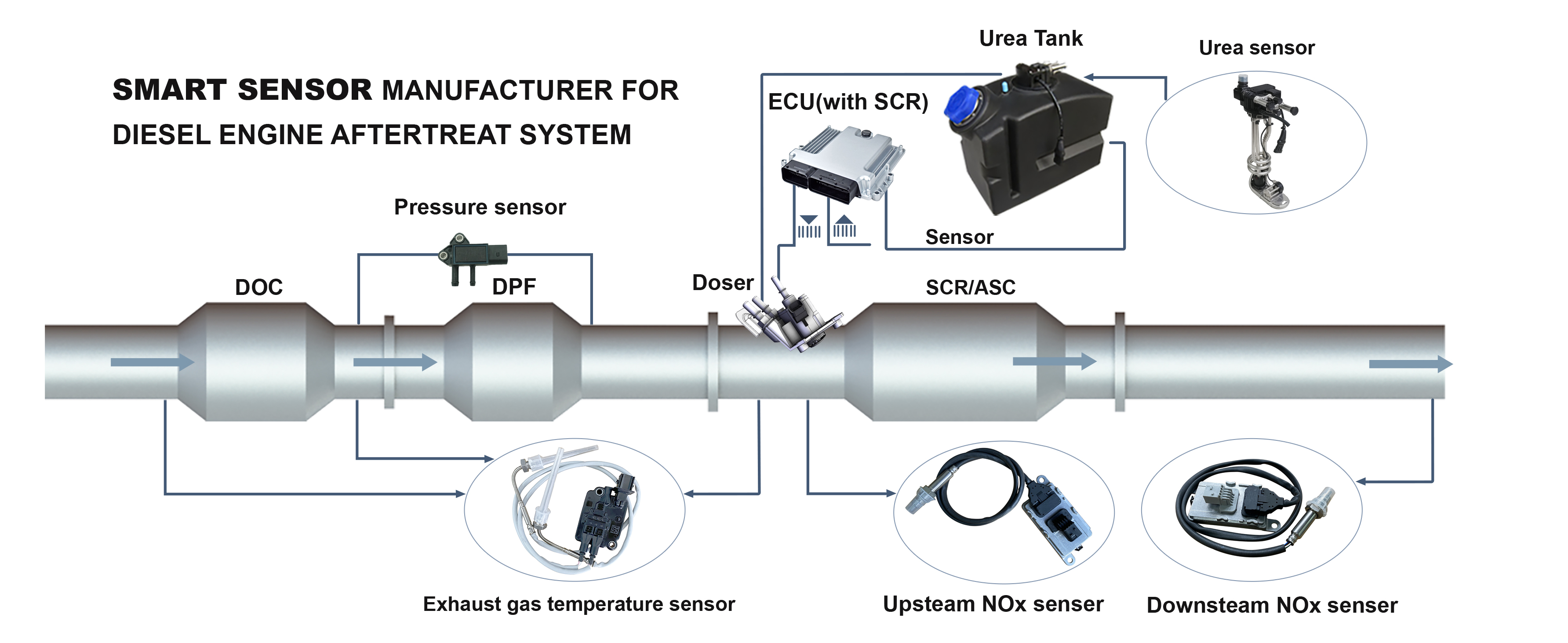
The NOx sensor acts as the feedback core of SCR selective catalytic reduction systems, paired with DOC, DPF, urea dosing pumps and SCR catalysts inside diesel exhaust pipelines. Two installation positions exist for industrial equipment: upstream NOx sensor before the catalyst and downstream NOx sensor after catalytic reaction. The two sensors deliver separate concentration data to ECU for urea injection adjustment. Diesel combustion generates NOx mixed in exhaust gas; urea liquid injected into pipelines decomposes into ammonia gas under high temperature. Ammonia reacts with NOx on catalyst surfaces to generate nitrogen and water vapor. The NOx sensor records post-reaction gas concentration and transmits data to adjust urea injection flow in real time.
Upstream sensors record raw NOx concentration before catalytic treatment to calculate theoretical urea demand. Downstream sensors monitor residual NOx after reaction to correct injection volume and balance conversion efficiency within the catalyst’s effective temperature band.
The sensor adopts solid electrolyte materials and Nernst concentration cell principles to calculate concentration differences between oxygen and NOx inside exhaust gas. Internal components generate corresponding electrical signals to separate oxygen and NOx concentration readings for ECU processing. The hardware structure supports continuous gas sampling under high-temperature exhaust environments.
Signal processing circuits inside the sensor filter electric noise generated by exhaust vibration and temperature fluctuation. Processed digital signals are transmitted to engine control units to support dynamic urea flow adjustment throughout equipment operation.
Parameter Item | Recorded Value |
|---|---|
Full Working Temperature Range | -40℃ – 800℃ |
SCR Catalyst High-efficiency Temperature Band | 200℃ – 400℃ |
Valid NOx Conversion Efficiency Interval | 80% – 97% |
The 80%–97% NOx conversion rate only applies when exhaust gas stays within the 200℃ – 400℃ catalyst temperature window. The NOx sensor itself maintains normal signal output outside this band, but SCR reaction efficiency will decline if exhaust temperature deviates from the high-efficiency interval. This two-part temperature distinction guides maintenance teams to judge system performance separately.
The sensor shell structure meets international ingress protection standards against water and dust particle penetration. The hardware can run continuously in dusty construction sites, farm field environments and outdoor generator stations without short-term performance decline.
Sensing elements are manufactured with high-temperature resistant raw materials. Under rated exhaust temperature and load conditions, the industry recorded service life interval stands at 30000 – 50000 operating hours. Replacement frequency depends on daily equipment running duration and exhaust impurity levels. This interval replaces the unsubstantiated 100000-hour value mentioned in early draft materials.
Embedded signal processing algorithms remove interference signals generated by exhaust particle impact and electromagnetic vibration from diesel engines. Clean concentration data reduces frequent urea injection correction and stabilizes long-term SCR system operation for commercial equipment.
The sealed shell and fixed internal sensing element structure reduce performance drift under frequent mechanical vibration. Off-road construction vehicles and emergency service machinery can adopt this sensor for continuous emission monitoring under harsh site conditions.
Sustained unstable NOx concentration readings transmitted to ECU signal possible sensing element drift or pipeline blockage. Maintenance teams can run diagnostic tools to read sensor output logs and arrange component inspection.
The sensor’s full working temperature range covers -40℃ low ambient temperature. Preheating circuits inside the hardware activate automatically after equipment startup to reach valid measurement state within fixed startup time.
ECU receives real-time upstream and downstream NOx data to adjust urea pump injection rate. Higher residual NOx readings from downstream sensors trigger increased urea supply; lower concentration signals reduce urea flow to cut material consumption for business operations.