close
Choose Your Site
Global
Social Media

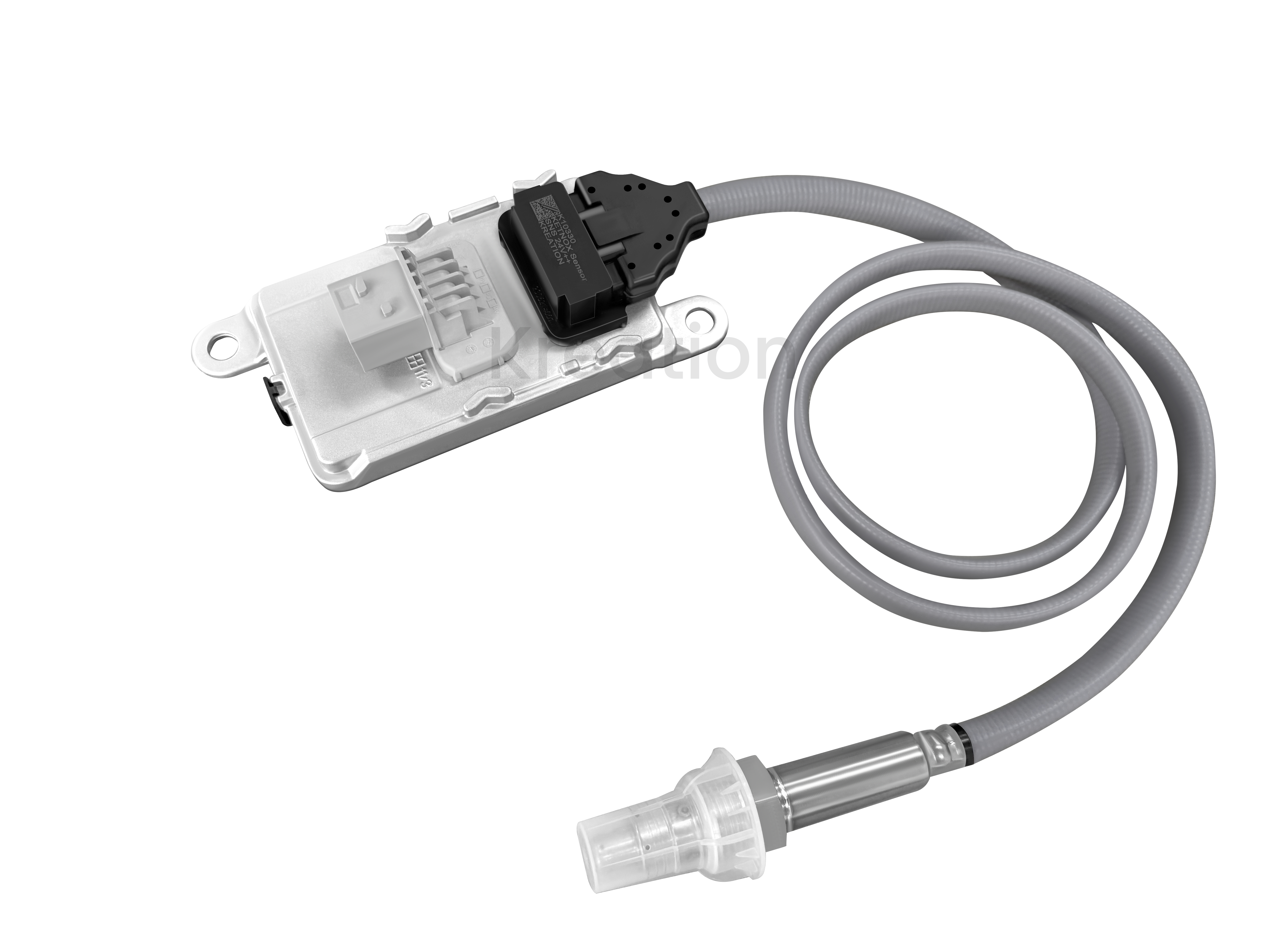
This NOx sensor serves as a core component of the Selective Catalytic Reduction (SCR) system for diesel exhaust aftertreatment. It delivers NOx concentration data to the SCR control system, which calculates the required Diesel Exhaust Fluid (DEF) dosage and drives the doser to inject fluid at the SCR inlet, reducing NOx levels at the system outlet. Developed by Kreation, this product line adheres to emission regulations in Europe, China, the United States, Japan, and South Korea, and matches the quality specifications of OEM products. Customization options for software, hardware, and structural design are available based on client requirements.
This sensor provides a cost-effective solution for nitrogen oxide measurement across multiple scenarios. It balances procurement cost with core functionality, suitable for commercial users that require accurate NOx monitoring without complex high-end sensing configurations.
The sensor adopts a straightforward structural design with a minimal number of components. This design reduces potential failure points associated with complex structures, and supports lower production and repair costs. The structural layout also supports straightforward installation and maintenance procedures for on-site technicians.
The sensor is equipped with standard analog or digital signal output, which allows integration with most common engine management systems. The standardized interface enables adoption by a wide range of users, from small commercial vehicle operators to industrial equipment operators, without additional complex adaptation work.
The sensor is engineered to work with various types of exhaust aftertreatment systems, including selective catalytic reduction (SCR) and lean-NOx traps. It provides NOx concentration data required for the regular operation of these systems, supporting stable operation of exhaust treatment processes.
This NOx sensor provides an alternative option for NOx measurement while retaining core sensing functions. It delivers NOx concentration readings at a lower price point, making it accessible to a broader range of commercial users and reducing initial procurement input for fleet and industrial equipment management.
The simplified structural design allows for quick installation with standard tools. With fewer components, routine maintenance and replacement procedures require less operation time, reducing the time and labor cost input for equipment upkeep and shortening equipment downtime.
The sensor works with different aftertreatment systems to support NOx emission reduction processes. It provides data required for these systems to run at set parameters, supporting stable NOx reduction performance and consistent exhaust emission levels.
Item | Specification |
|---|---|
Nox Detection Range | 0-2500ppm O2: -12%-21% |
Nox Accuracy | 0-100ppm: ±10ppm; 100-500ppm: ±10%; 500-1500ppm: ±15%; 1500-2500ppm: ±30% |
O2 Accuracy | 0%-5%: ±0.25%; 5%-21%: ±5% |
Light-off Time | Can reach detection state in 160s |
Response Time | T(10-90%): Nox < 5300ms; T(10-90%): O2 - 4900ms |
Supply Voltage | 12V, 24V in universal version |
Design Life | 6000h or 350000km |
For operators of small commercial vehicles, such as local delivery vans and light trucks, this cost-efficient NOx sensor is a practical option. It supports these vehicles in meeting local emission regulations without large investment in high-end sensing technology, suitable for fleet operation with cost control requirements.
In small-to-medium industrial facilities, such as workshops and factories with moderate engine power requirements, the sensor supports stable NOx monitoring for fixed power equipment. It adapts to various industrial engine configurations and assists in maintaining compliant exhaust emissions for stationary power systems.
This NOx sensor is compatible with common exhaust aftertreatment systems including selective catalytic reduction (SCR) systems and lean-NOx traps. It provides NOx concentration data to support the regular operation of these treatment systems.
The universal version of this sensor supports both 12V and 24V supply voltage, adapting to different vehicle and industrial equipment power systems without additional voltage conversion components.
Under standard operating conditions, the sensor has a design life of 6000 hours or 350000 kilometers. Actual service life may vary based on operating environment, exhaust composition and routine maintenance conditions.