close
Choose Your Site
Global
Social Media
Views: 0 Author: Site Editor Publish Time: 2026-10-15 Origin: Site
Exhaust system-related Check Engine Lights (CEL) are notoriously difficult to pin down. They often point generically to the emissions system, leaving you guessing. Both sensors thread directly into the exhaust pipe. They endure extreme heat and monitor exhaust gases constantly. This physical similarity creates visual confusion for many mechanics and vehicle owners. However, their operational goals are entirely distinct. Misdiagnosing one for the other leads to wasted money and unresolved engine issues.
Oxygen (O2) sensors manage engine combustion efficiency. Conversely, NOx sensors monitor post-combustion emissions reduction effectiveness. You will find these primarily in diesel and modern lean-burn engines. In this guide, we will break down exactly how these components differ. We will explore their specific mechanisms, exhaust placements, and unique diagnostic footprints. You will also learn practical tips for troubleshooting and replacement, helping you restore optimal vehicle performance quickly and safely.
Primary Function: Oxygen sensors adjust the engine’s air-fuel ratio in real-time; NOx sensors measure nitrogen oxide levels to evaluate the Selective Catalytic Reduction (SCR) system.
Engine Type Bias: O2 sensors are standard on virtually all modern internal combustion engines (gas and diesel). NOx sensors are predominantly found on modern diesel engines (and select stratified-charge gas engines) to meet Euro 6 and EPA emissions standards.
Diagnostic Footprint: A failing O2 sensor typically causes poor fuel economy and rough idling. A failing NOx sensor often triggers DEF (Diesel Exhaust Fluid) system warnings, limp mode, or a countdown to engine no-start.
Cost Reality: NOx sensors are significantly more complex (featuring dual-chamber ceramic technology and integrated control modules) and are therefore noticeably more expensive to replace than standard O2 sensors.
An oxygen sensor acts as the primary respiratory monitor for an engine. It measures unburned oxygen present in the exhaust stream. As exhaust gases flow past the sensor tip, the internal component detects oxygen density differences between the exhaust and outside air. This data feeds directly back to the Engine Control Module (ECM).
The ECM uses this real-time feedback to maintain the ideal stoichiometric air-fuel ratio. For standard gasoline engines, this ratio is 14.7:1. If the mixture runs rich, the sensor signals the computer to reduce fuel. If it runs lean, the computer adds fuel. Most traditional O2 sensors utilize a simple zirconium dioxide element. This element generates a small voltage, typically between 0.1 and 0.9 volts, based on oxygen differentials.
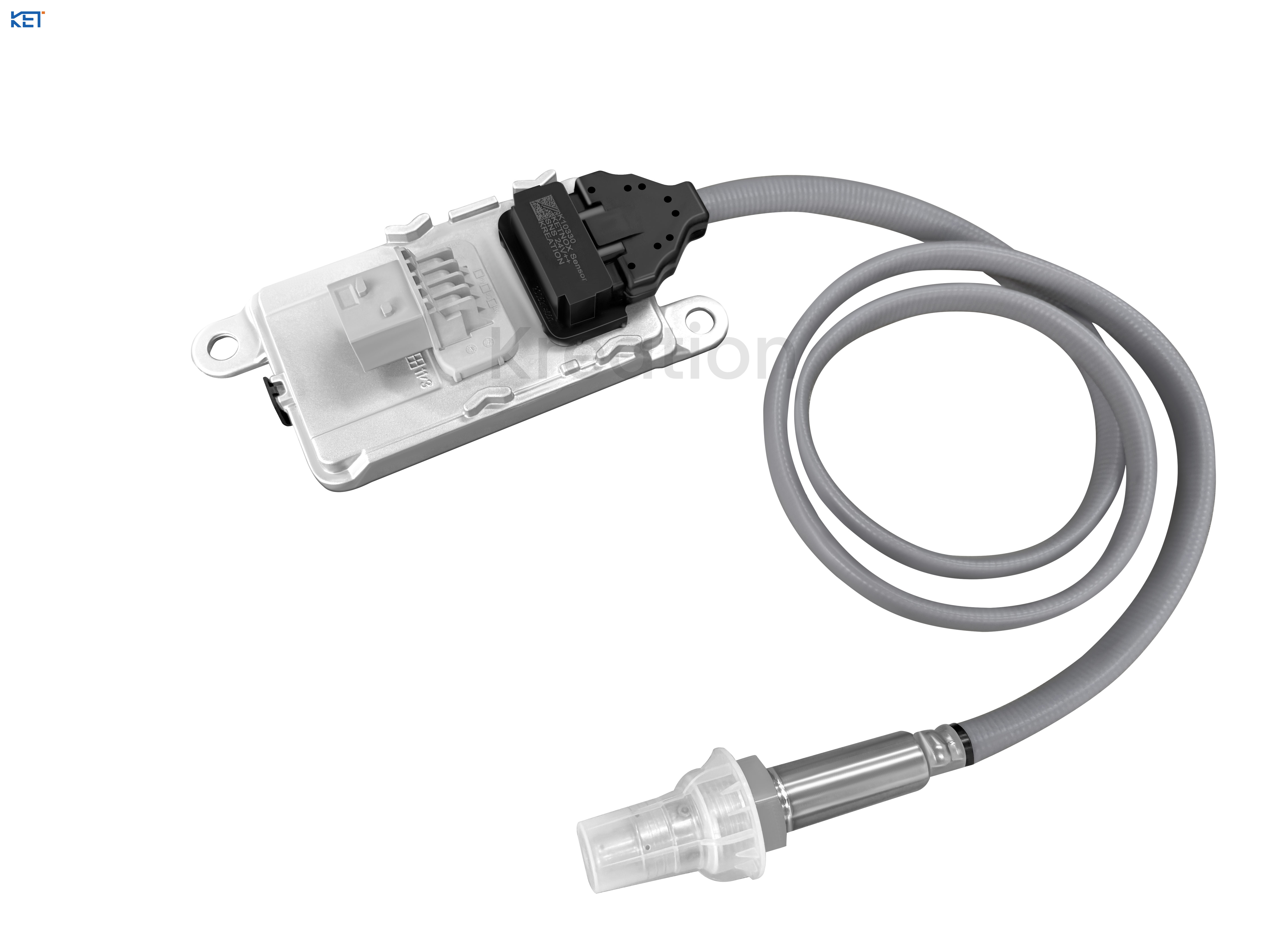
While an oxygen sensor optimizes combustion, a NOx Sensor serves a strictly environmental purpose. It measures the exact concentration of nitrogen oxides (NO and NO2) leaving the engine and exiting the SCR catalyst. These harmful gases require precise neutralization to meet strict environmental regulations.
To achieve this, the sensor operates via a highly sensitive, heated electro-ceramic element. It combines this element alongside a dedicated micro-controller, often called the NOx module. The operational flow generally follows these specific steps:
The sensor heats up to its optimal operating temperature to ensure accurate readings.
The internal dual-chamber pulls in exhaust gas and pumps out excess oxygen.
The remaining nitrogen oxides break down into nitrogen and oxygen.
The micro-controller translates this chemical reaction into a precise parts-per-million (PPM) signal.
The ECM dictates the exact dosing of Diesel Exhaust Fluid (DEF) required to neutralize the emissions.
Engineers position oxygen sensors strategically to monitor both engine performance and catalytic converter health. You will find them grouped into two distinct categories based on their location.
Upstream sensors, commonly known as Sensor 1, sit near the exhaust manifold. They monitor untreated exhaust gases straight from the combustion chamber. Their primary job is adjusting fuel trim continuously. Downstream sensors, or Sensor 2, sit immediately after the catalytic converter. They verify catalyst efficiency by ensuring the converter successfully scrubs hydrocarbons and carbon monoxide from the exhaust flow.
Modern diesel emissions systems require a similarly layered approach. Manufacturers integrate these sensors directly into the Selective Catalytic Reduction (SCR) framework. This setup creates a closed-loop monitoring environment.
The upstream sensor mounts before the SCR catalyst. It measures raw, engine-out NOx levels before any chemical treatment occurs. The downstream sensor mounts after the SCR catalyst. It ensures the DEF injection successfully reduced the harmful gases to legal compliance levels. If the downstream reading matches the upstream reading, the system immediately flags a major emissions failure.
Sensor Designation | Physical Location | Primary Diagnostic Role |
|---|---|---|
Upstream O2 | Before Catalytic Converter | Adjusts real-time fuel trim |
Downstream O2 | After Catalytic Converter | Verifies catalyst efficiency |
Upstream NOx | Before SCR Catalyst | Measures baseline engine-out emissions |
Downstream NOx | After SCR Catalyst | Confirms successful DEF neutralization |
A failing oxygen sensor rapidly destabilizes engine performance. Because it controls fuel delivery, a malfunctioning unit forces the engine to guess the correct air-fuel mixture. This guessing game produces obvious drivability issues.
Key symptoms include a noticeable drop in miles per gallon (MPG), engine surging, and hesitation upon acceleration. You might also notice a distinct rotten egg smell coming from the tailpipe. A scanner will typically reveal common trouble codes (DTCs) ranging from P0130 through P0167. These codes indicate heater circuit malfunctions, slow response times, or voltage irregularities.
When this emissions component fails, the vehicle behaves entirely differently. The engine itself might run fine, but the emissions control system goes into a self-preservation panic. This triggers severe restrictions designed to force the driver into a repair shop.
Key symptoms include frequent Diesel Particulate Filter (DPF) regenerations and increased DEF consumption. Dashboard warnings become highly aggressive. You will often see messages like "Speed limited to 50 MPH in 100 miles." Common trouble codes include P2200 through P2225, indicating circuit errors. You may also see P20EE, which means SCR efficiency has dropped below the required threshold.
Relying solely on a basic code reader is highly risky. A code indicating a sensor fault does not guarantee the sensor itself is broken. Wiring damage, exhaust leaks, or blown fuses trigger identical codes.
You must use live-data scanning. Verify the sensor voltage and operating temperature before ordering expensive parts. For O2 diagnostics, look for rapid voltage switching between 0.1v and 0.9v. For emissions diagnostics, monitor the PPM readings under heavy engine load. If the PPM value remains static during acceleration, the module is likely dead.
Budgeting for exhaust repairs requires understanding the massive price gap between these two components. Oxygen sensors operate as relatively simple, mass-produced commodity parts. They boast simple plug-and-play installation. A standard unit rarely breaks the bank.
Conversely, emissions-focused sensors are high-cost components. They incorporate an integrated control module directly into the wiring harness. Manufacturers sell them as a unified sensor-and-module unit. The dual-chamber ceramic technology and built-in microprocessors drive replacement prices significantly higher.
When shopping for replacements, brand selection dictates long-term success. For standard O2 units, high-quality aftermarket brands like Bosch or Denso are highly reliable. They dominate the market and enjoy wide acceptance among professional technicians.
However, we strongly recommend sticking to OEM or OES (Original Equipment Supplier) for emissions modules. Cheap aftermarket alternatives frequently suffer from severe calibration errors. These errors lead to immediate returning CELs and frustrating SCR system lockouts. A budget NOx Sensor often fails to communicate properly across the vehicle's CAN bus network.
Physical installation presents its own set of challenges. Exhaust pipes endure constant heating and cooling cycles. This environment creates difficult removal scenarios.
Seized threads: Both sensors frequently weld themselves to the exhaust pipe. Mechanics often require heat induction tools or specialized penetrating fluids to break them loose safely.
Thread chasing: Always clean the bung threads before installing the new unit to prevent cross-threading.
Programming and Adaptation: Installing a new emissions module often requires a bi-directional scan tool. You must reset the SCR adaptations in the ECM. Standard oxygen sensors typically require no programming whatsoever.
Many mechanics attempt to save money by cleaning dirty exhaust components. This approach guarantees failure. Using carb cleaner, brake fluid, or wire brushes on the sensitive ceramic tips destroys the microscopic pores.
These pores must remain completely unobstructed to measure gas particles accurately. Chemical solvents contaminate the zirconium elements instantly. If soot accumulation causes poor readings, you can sometimes burn it off via forced DPF regeneration. High exhaust gas temperatures naturally clean the sensor tip. Never attempt manual chemical cleaning.
Frustrated owners sometimes turn to the "NOx/DEF delete" aftermarket. They modify their ECM software to bypass emissions monitoring entirely. We strongly advise against this approach.
Bypassing these systems carries severe legal compliance risks. Environmental agencies impose hefty fines on individuals and shops caught tampering with emissions controls. Furthermore, installing delete tunes immediately voids all manufacturer warranties. It also drastically reduces the resale value of the vehicle in heavily regulated markets.
No exhaust component lasts forever. O2 sensors generally last between 60,000 and 100,000 miles before their reaction times slow down. Routine maintenance and high-quality fuel can extend this lifespan.
Emissions monitoring modules face a harsher reality. They typically fail between 50,000 and 80,000 miles. Soot contamination, water condensation in the exhaust, and extreme thermal shock degrade the ceramic chambers rapidly. Heavy idling and frequent short trips accelerate this degradation significantly.
While both sensors live in the harsh environment of the exhaust system, misdiagnosing one for the other leads to wasted money and unresolved engine issues. Oxygen sensors dictate how your engine breathes and burns fuel. In contrast, emissions modules ensure your vehicle complies with strict environmental standards by monitoring DEF dosing.
Always verify live data before purchasing replacement parts. Look closely at voltage fluctuations for combustion monitors and PPM readings for emissions units. Swapping parts based solely on a generic trouble code is an expensive guessing game.
Finally, when dealing with SCR system repairs, cutting corners rarely pays off. Investing in a genuine OEM component and performing the proper ECM resets remains non-negotiable. Following these strict diagnostic and replacement procedures ensures long-term vehicle reliability and keeps your engine running flawlessly.
A: Yes, occasionally. If an upstream O2 sensor creates an extremely lean condition, engine-out NOx levels will spike. This spike can potentially overwhelm the SCR system, triggering a secondary emissions efficiency code. You should always fix fuel trim issues before replacing emissions modules.
A: These sensors contain miniature computerized modules to process complex data. They also require precious metals inside dual-chamber ceramic designs. This advanced hardware separates oxygen from nitrogen oxides accurately, making manufacturing costs significantly higher than standard exhaust components.
A: Temporarily, yes. However, modern diesel ECMs track emissions compliance strictly. They are programmed to induce a "limp mode" or restrict engine starting if emissions fall out of compliance for an extended mileage period. You should schedule repairs immediately upon seeing dashboard warnings.